 Fellow Canadians: All inFlow plans are available in Canadian dollars






Key takeaways
- Contractor quotes are in-depth, legally binding agreements that specify exact costs, services, exclusions, and timelines. They often include a “valid until” date to protect contractors from unforeseen changes.
- Estimates are rough, non-binding cost approximations used for initial planning and budgeting. They provide a general overview of services, labor, timelines, and potential exclusions.
- Both estimates and quotes serve as essential documents that contractors should use throughout a project to aid in defining scope, budget control, accountability, and post-project financial reporting.
- Bids are typically used for large-scale public or commercial projects, where contractors submit proposals in response to detailed project specifications provided by clients.
- Contractors should only provide quotes after thoroughly assessing project requirements through client discussions, site visits, or research to ensure accuracy and feasibility.
If you’re new to working with a contractor (or maybe you’re a new contractor yourself), you’ll often hear a few terms, such as quotes, estimates, bids, and proposals. While many use these terms interchangeably, there are some small but significant differences between them. So: what is a quote vs. estimate? What do you need to know about contractor quotes? Is there specific information contractor quotes should include? What about bids and proposals?
There’s a lot to talk about here, so let’s jump in without further ado!
What’s the difference between a contractor quote and an estimate?
Contractor quotes and contractor estimates are similar, but they are not the same. In any contractor quote vs estimate comparison, the difference comes down to detail, accuracy, and commitment.
An estimate is a rough projection. A quote is a more detailed offer that may function as a legally binding contractor quote once accepted.
What a contractor estimate includes
A contractor estimate is an early-stage projection of what a project is likely to cost. It gives the customer a general idea of the work required, the expected price range, and the rough project timeline.
Most estimates include:
- Project overview and scope of work
- Estimated labor costs
- Estimated material costs
- Preliminary project timeline
- Key assumptions used to calculate costs
- Potential exclusions or limitations
- Estimated total project cost or cost range
- Disclaimer that pricing is subject to change
Because estimates are meant to be approximate, they are not usually legally binding. The final price may change once the contractor has more information.
What a contractor quote includes
An itemized contractor quote is more detailed and accurate than an estimate. It outlines the specific work to be completed, the materials and labor required, the project timeline, and the total price.
Most quotes include:
- Detailed scope of work
- Itemized labor costs
- Itemized material costs
- Equipment or subcontractor costs (if applicable)
- Project timeline and milestones
- Payment terms and schedule
- Inclusions and exclusions
- Total quoted price
- Quote expiration or “valid until” date
- Terms and conditions
- Change order process for additional work
- Customer acceptance/signature section (if applicable)
Because quotes are more formal, contractors should only provide one once they’re confident in the project scope and costs. That might mean speaking directly with the customer, walking the job site, taking measurements, or confirming supplier pricing.
Can a contractor quote become binding?
Yes, a contractor quote can become legally binding if the customer accepts and signs it. At that point, the quote may function like a contract, depending on the wording of the document and the laws in your area.
That’s why accuracy matters. Before sending a quote, contractors should make sure the scope of work and exclusions, pricing, timeline, and terms are clearly defined.
In short, an estimate gives the customer a rough idea of what a project might cost. A quote gives them a much firmer price and, when accepted, can create a formal agreement between the customer and contractor. If a client agrees on a price and tries to renege on it, they’ll end up in legal trouble. A lot of legal trouble.
When should contractors use an estimate and when should they send a quote?
Knowing when to send an estimate versus a quote can help contractors set clear expectations, avoid pricing disputes, and protect their profit margins. While both documents help customers understand project costs, they serve different purposes and are used at different stages of the process.
Use an estimate during early planning and site discovery
Estimates work best when project details are still being finalized. At this stage, the scope of work should be clearly defined, material costs should be known, labor requirements should be reasonably predictable, and the quote validity period should be realistic.
Providing an estimate allows you to give customers a realistic budget range without committing to a final price. This is especially useful for projects that are still in the planning phase or require additional inspections before work can begin.
Many contractors use estimates during initial consultations to help customers determine whether a project is financially feasible before investing time in detailed planning.
Use a quote after scope, labor, and materials are confirmed
A quote should be provided once you have enough information for accurate job costing. This typically happens after site visits, measurements, supplier pricing checks, and discussions about project requirements.
At this stage, the scope of work should be clearly defined, material costs should be known, labor requirements should be reasonably predictable, and the quote validity period should be realistic. Because customers often treat quotes as firm pricing, accuracy is critical.
Sending a quote too early can expose contractors to unexpected costs, material price increases, or scope changes that reduce profitability.
How to move from estimate to quote without confusion
The easiest way to avoid misunderstandings is to clearly communicate that an estimate is preliminary and subject to change. Label estimates appropriately and explain what assumptions were used to calculate the projected cost.
As project details become clearer, you can revise the estimate or issue a formal quote that reflects the confirmed scope of work and explains the change order process if additional work is added. Many contractors include notes outlining what information still needs to be verified before final pricing can be provided.
By treating estimates as planning tools and quotes as finalized pricing documents, contractors can keep customers informed while reducing the risk of disputes later in the project.
Quotes vs estimates vs bids vs proposals
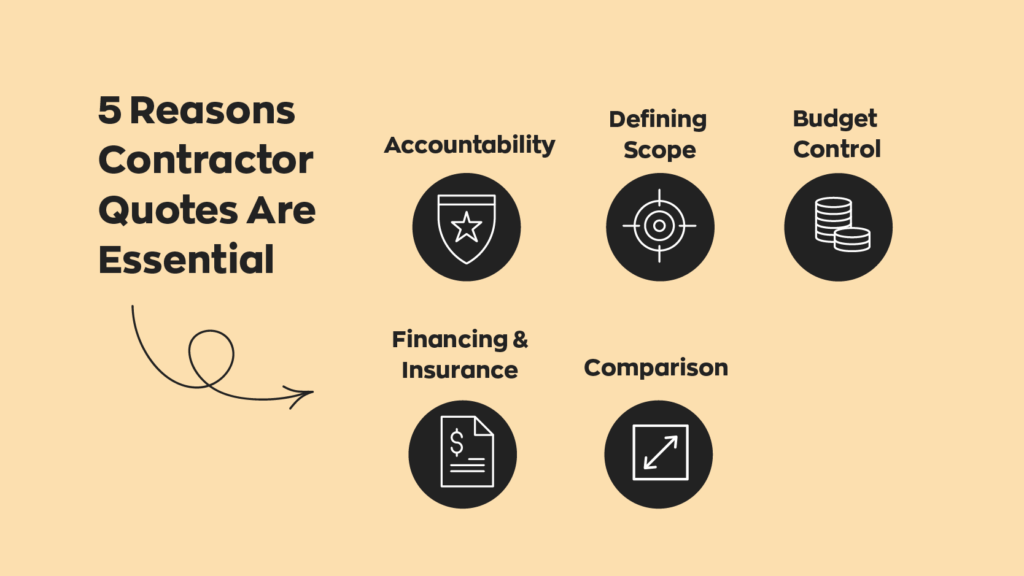
In addition to quotes and estimates, contractors also commonly use both bids and proposals. The type of document you use depends on the circumstances. Estimates and quotes are the most common for residential and small commercial work, while bids and proposals are often used for larger commercial or government projects.
Understanding the differences can help contractors choose the right document for the type of construction project and communicate more clearly with potential customers.
What is a bid?
A bid is a formal offer to complete a project for a specified price and timeline, usually as part of a competitive selection process. Unlike estimates and quotes, bids are commonly used for large commercial, municipal, and government projects.
When an organization wants to complete a project, it typically publishes the project requirements and invites contractors to submit bids. Contractors then compete by outlining their costs, timelines, qualifications, and approach to the work. The project owner reviews the submissions and selects the bid that best meets their needs.
Because bids are often used for large-scale projects, they tend to be far more detailed than estimates or quotes. Contractors may need to provide extensive cost breakdowns, project schedules, staffing plans, safety procedures, and supporting documentation as part of the submission process.
What is a proposal?
A proposal is a sales document designed to convince a customer that your company is the best choice for a project. While proposals often include pricing information, their primary purpose is to showcase your expertise, experience, and value.
Most proposals contain many of the same elements as estimates and quotes, but they go much further by explaining how the contractor plans to complete the work and why their approach is the right one. This may include project methodologies, case studies, timelines, qualifications, certifications, or cost-saving recommendations.
Contractors often use proposals when responding to requests for proposals (RFPs), competing for larger projects, or pitching work to customers who are evaluating multiple companies.
Which document fits residential vs commercial projects?
For most residential projects, estimates and quotes are the primary documents contractors use. This is because commercial projects often require additional documentation. Small commercial jobs may still use estimates and quotes, but larger projects frequently involve proposals and competitive bids. Government contracts, infrastructure projects, and large-scale commercial developments almost always use a formal bidding process.
In general:
- Estimates are best for early budgeting and project planning.
- Quotes are best when pricing and scope have been confirmed.
- Proposals are best when you need to demonstrate value and win a customer’s business.
- Bids are best for competitive commercial or government procurement processes.
The larger and more competitive the project becomes, the more likely contractors are to move from simple estimates and quotes toward detailed proposals and formal bids.
Why these documents matter for scope, budget, and client approval
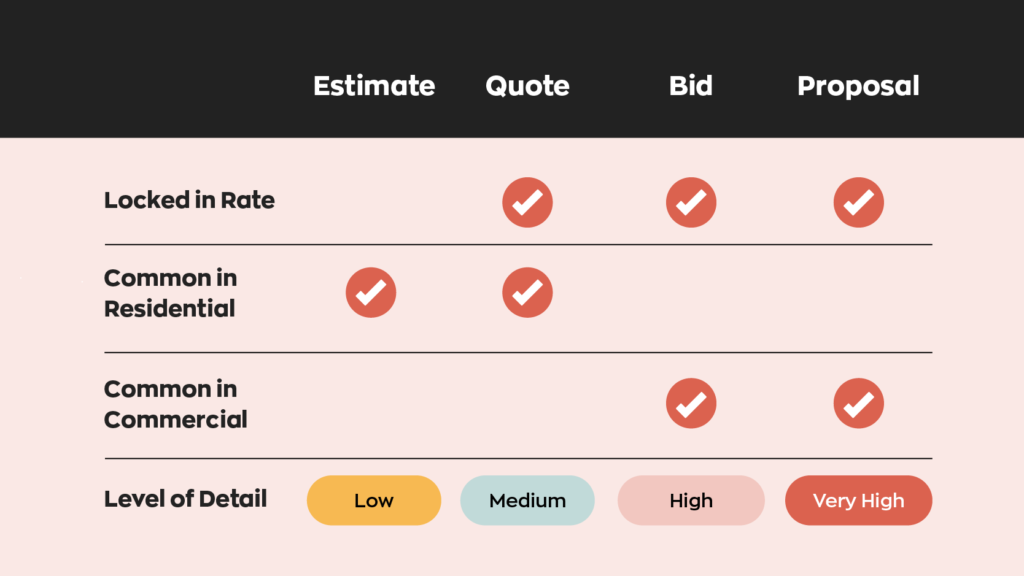
Whether you’re creating an estimate, quote, bid, or proposal, these documents do far more than communicate pricing. They help contractors define project expectations, document requirements, and create a clear record of what has been discussed and agreed upon.
When used properly, they can reduce misunderstandings, improve project planning, and make it easier to keep jobs on track from start to finish.
Better client expectations
One of the biggest causes of project disputes is misaligned expectations. Customers may assume certain work is included, expect a different timeline, or misunderstand how pricing was calculated.
Estimates, quotes, bids, and proposals help eliminate this confusion by clearly outlining the scope of work, expected costs, project timelines, and any exclusions. When both parties understand exactly what’s included, there is far less room for surprises later.
Clear documentation also makes it easier for customers to compare options and confidently approve a project.
Better budget control
Accurate project documents help contractors understand the labor, materials, equipment, and subcontractor costs associated with a job before shovels hit the dirt (so to speak).
By documenting costs upfront, contractors can identify potential budget issues early, plan purchasing requirements, and track whether the project remains profitable as work progresses. This is especially important on larger projects where even small cost overruns can significantly impact margins.
The more detailed the documentation, the easier it becomes to forecast costs and manage resources effectively.
Better project accountability
Project documents create a written record of what was proposed, approved, and agreed upon. This provides accountability for both contractors and customers throughout the project lifecycle.
If questions arise about pricing, timelines, materials, or scope changes, contractors can refer back to the original estimate, quote, bid, or proposal to clarify what was included. This helps reduce disputes and provides valuable documentation if changes need to be approved later.
Just as importantly, these documents keep project information organized and accessible. This makes it easier to manage jobs, communicate with customers, and maintain consistency across your business.
How to track quotes, estimates, materials, and change orders
Keeping track of quotes, estimates, materials, and change orders can get messy fast. In the past, contractors relied on paper documents, physical signatures, filing cabinets, and a lot of manual follow-ups.
And it worked. Technically. But it also made it easy for documents to get lost, material usage to go untracked, and project costs to drift far from the original projections.
Today, contractors can use field service management software to keep project information, inventory, and job costing in one place, which makes job costing for contractors easier to manage and review. This makes it easier to see what was quoted, what materials were used, what changed during the job, and whether the project stayed profitable.
Job costing and inventory visibility
Accurate job costing starts with knowing what each job actually requires. That includes labor, materials, equipment, and any additional costs that come up along the way.
Inventory and field service software can help contractors track materials as they are purchased, assigned, and used on jobs. Instead of guessing whether parts are available or manually updating spreadsheets after the fact, teams can see stock levels in real time and understand how material usage affects project costs.
This helps contractors avoid stockouts, reduce unnecessary purchases, and calculate a more accurate cost of goods sold (COGS) for each job.
Barcode and asset tracking for field teams
Field teams also need a reliable way to track tools, equipment, and materials across job sites. Without a system in place, it’s easy for items to go missing or sit unused in the wrong truck when another technician needs them.
Barcodes make tracking everything much easier. Teams can scan items as they are received, moved, assigned, or used, creating a clearer record of where materials and equipment are at any given time.
For contractors, this means less time spent hunting for tools, fewer work stoppages due to missing materials, and better visibility across warehouses, trucks, and job sites.
Reporting, margins, and follow-up
Tracking project documents and material usage also gives contractors better reporting. When quotes, estimates, purchase history, inventory levels, and job costs are connected, it becomes easier to understand which jobs are profitable and where margins are being lost.
Reports can help contractors compare estimated costs against actual costs, review material usage, identify pricing issues, and follow up on open quotes or unpaid work.
The good news is that this does not have to be handled with paper files or disconnected spreadsheets anymore. With the right system in place, contractors can keep their projects organized, their materials accounted for, and their margins easier to protect.
0 Comments