 Fellow Canadians: All inFlow plans are available in Canadian dollars





Key takeaways
- Types of construction by project purpose are residential, commercial, industrial, infrastructure, environmental, specialized, and modular/prefabricated.
- The building construction types defined by the IBC are Type I (Fire-Resistive), Type II (Non-Combustible), Type III (Ordinary), Type IV (Heavy Timber), and Type V (Wood Frame).
- Understanding both classifications is essential for compliance, safety planning, cost estimation, and design.
- Each construction type comes with unique inventory management challenges that can derail a project if left unaddressed.
- Best practices like barcoding, safety stock, and cloud-based inventory software can help keep any construction project on track.
“Construction types” is one of those terms that gets thrown around a lot in the industry, but its meaning can shift depending on the context and who you’re talking to. On one hand, construction professionals use it to describe the purpose of a project. For instance, residential, commercial, industrial, and so on. On the other hand, building codes like the International Building Code (IBC) use it to classify structures based on fire resistance.
Obviously, both definitions matter, and understanding the difference between them can save you from costly mistakes down the line. So, let’s break down both definitions so that, no matter the context, you’ll be well informed.
Types of construction by project purpose
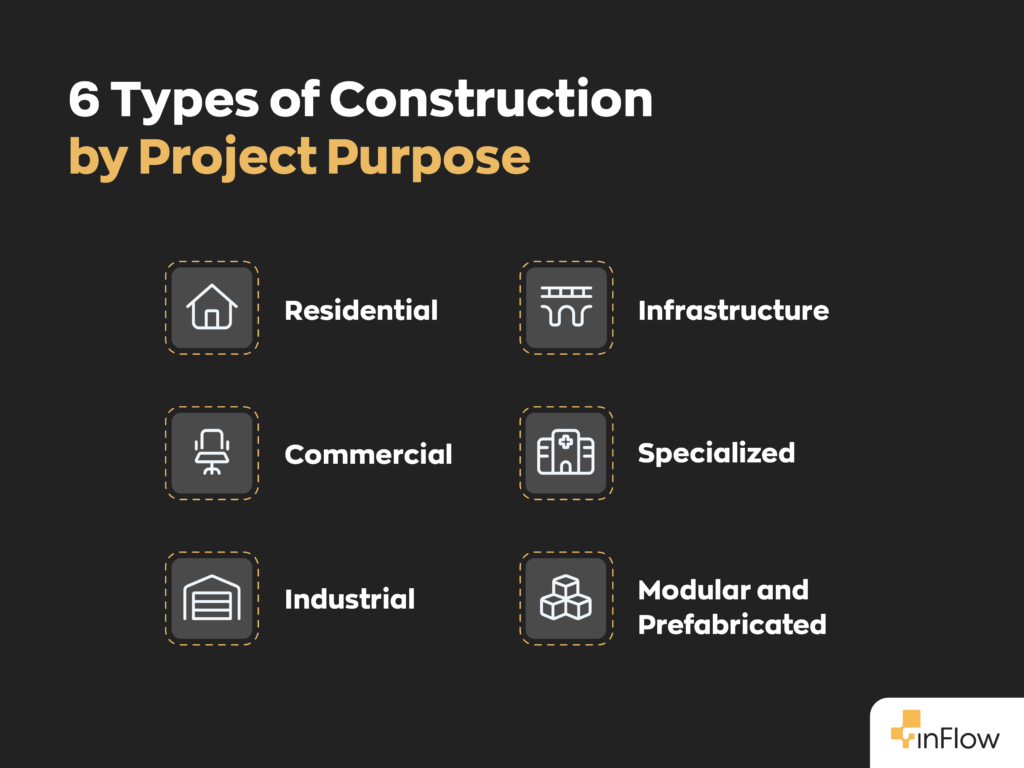
When contractors talk about types of construction, they’re most often referring to what’s being built and why. Here’s a quick rundown of the major categories.
Residential construction
Residential construction covers any structure built for people to live in. This could be single-family homes, townhouses, apartment complexes, and condominiums. These projects tend to be smaller in scale but are often high volume.
Commercial construction
Commercial construction includes office buildings, retail spaces, hotels, restaurants, and shopping centers. These projects are typically more complex than residential builds, involving specialized HVAC systems, fire suppression systems, and commercial-grade electrical systems.
Industrial construction
Industrial construction involves facilities built for manufacturing, processing, or storage. Think factories, warehouses, power plants, and refineries. These projects must adhere to strict safety regulations and often require specialized builds to accommodate heavy-duty materials.
Infrastructure construction
Infrastructure construction refers to the public systems that keep society running. Roads, bridges, tunnels, railways, water treatment facilities, and power grids all constitute infrastructure construction. These are often large-scale, government-funded contracts with long timelines.
Specialized construction
Specialized construction covers niche projects that don’t fit neatly into other categories, including hospitals, data centers, sports arenas, and military facilities. It also includes work focused on protecting or restoring the environment, like flood control systems, wetland restoration, and waste management facilities. These projects usually require highly specific expertise, materials, and processes to get right.
Modular and prefabricated construction
Modular and prefabricated construction involves an off-site manufacturing process that produces components to be assembled on site. It’s a fast-growing segment of the industry, mainly because it’s quicker, more cost-effective, and generates less waste than traditional methods.
Building construction types: the IBC classification system
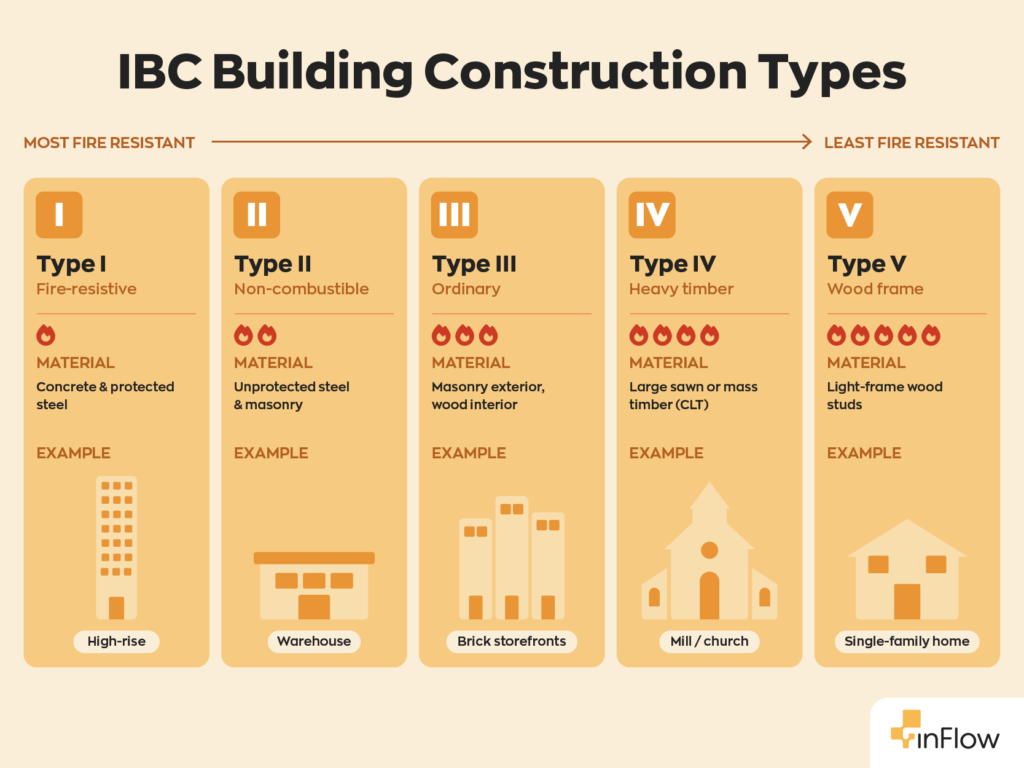
The other way contractors talk about types of construction is a little more technical. The International Building Code (IBC) classifies buildings into five construction types based on how well their structural components resist fire. These classifications directly influence design requirements, material choices, and safety planning.
Type I: Fire-Resistive
Type I buildings are the gold standard for fire resistance. Commonly built of reinforced concrete and protected steel. Type I-A typically requires up to 3-hour fire-resistance ratings, while Type I-B typically requires 2-hour ratings. You’ll find this classification in high-rise residential buildings, hospitals, and large commercial towers. They’re expensive to build, but they’re built to last.
Type II: Non-combustible
Type II buildings also use non-combustible materials like steel and concrete, but with less fireproofing than Type I. Type II-A commonly requires 1-hour ratings while Type II-B commonly requires 0-hour ratings. Modern schools, shopping malls, and big-box retail stores often fall into this category.
Type III: Ordinary
Also known as brick-and-joist construction, Type III buildings feature non-combustible exterior walls (usually masonry) paired with combustible interior elements like wood framing. Many older commercial buildings and mixed-use developments fall in this category. Fire can spread more easily through interior spaces, so additional suppression systems are often required.
Type IV: Heavy Timber
Type IV construction uses large-dimension solid or laminated wood for structural elements, including both traditional heavy timber and newer mass timber systems. You may see this broken into subtypes like IV-A, IV-B, IV-C (mass timber), and IV-HT (heavy timber), each with different fire-resistance requirements.
What makes this type unique is how it performs in a fire. The thick timber chars slowly, which helps maintain structural integrity longer than you might expect. Old factories, churches, and barns are classic examples. And more recently, mass timber has been making a comeback in modern, sustainable commercial construction.
Type V: Wood Frame
Type V is the most common and most combustible construction type. It allows for wood framing throughout, making it fast and affordable to build. Most, but not all, single-family homes fall into this category. While fire-retardant treatments and sprinkler systems help, these structures are largely the most vulnerable in a fire.
Why understanding construction types matters
So, why does any of this matter beyond passing a licensing exam? Quite a bit, actually.
- Compliance: Building codes require specific construction types for certain occupancies and heights. Getting this wrong can result in failed inspections, costly redesigns, or legal liability.
- Safety planning: Firefighters use construction-type classifications to determine how to approach a burning building. Knowing the type can literally save lives.
- Cost estimation: Material requirements vary significantly between construction types. Construction material costs for Type I buildings will be considerably higher per square foot than for Type V structures.
- Design requirements: Architects and engineers must design within the constraints of the applicable construction type, which affects everything from wall assemblies to egress planning.
Inventory management challenges by construction type
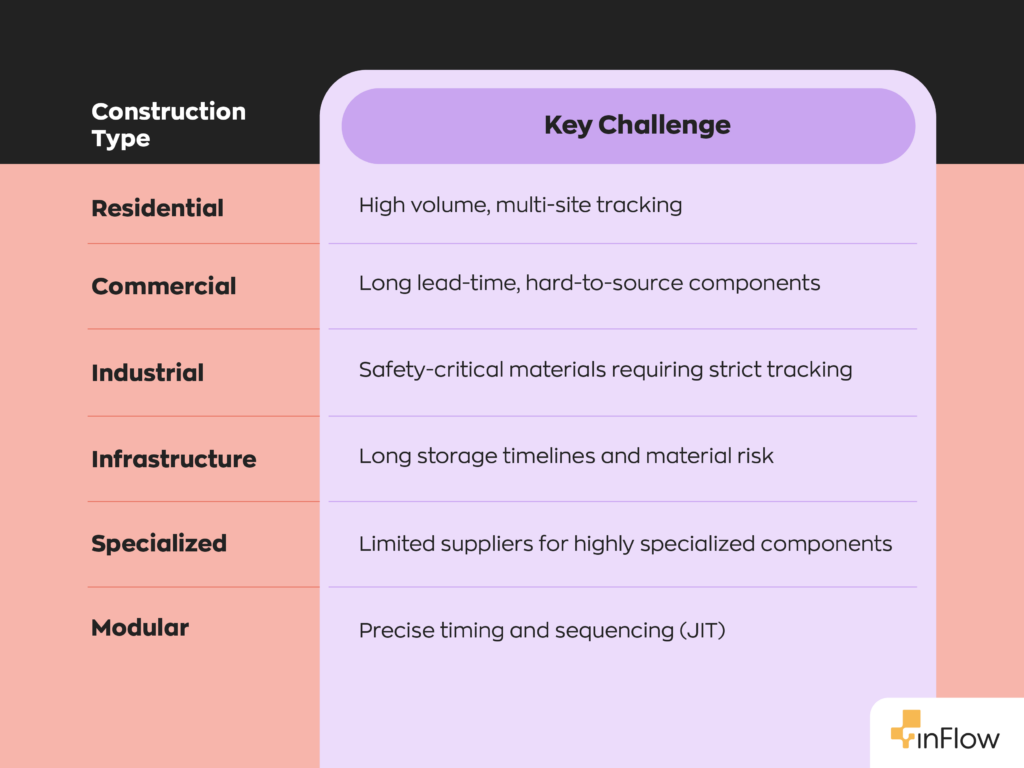
No matter which type of construction you’re working on, it will come with its own inventory headaches. Here are some common challenges you’ll likely encounter for each type of construction.
- Residential: High project volume means managing a large number of similar materials across multiple sites simultaneously. Think new subdivisions. Keeping track of lumber, fixtures, and finishes without a unified inventory tracking system is a disaster.
- Commercial: Specialized systems like commercial HVAC units and fire suppression components are harder to source which means longer lead times. A delay in one component can stall an entire project.
- Industrial: Heavy equipment, bulk raw materials, and safety-critical components all need to be tracked meticulously. These buildings are constructed under strict regulations so errors here aren’t just costly, they’re dangerous. Not to mention they could delay or even jeporize the completion of a project.
- Infrastructure: Long project timelines mean materials need to be stored for extended periods, increasing the risk of damage, theft, or obsolescence. It also means more purchasing over longer periods of time. More volume always means more room for error.
- Specialized: Hospitals, data centers, and similar facilities require highly specialized components, including medical-grade materials, precision cooling systems, and custom-fabricated parts. These materials are often sourced from a limited number of suppliers, which means substitutions are rarely an option, making accurate forecasting and supplier relationships critical.
- Modular/Prefabricated: Tight manufacturing schedules mean components need to arrive on-site at exactly the right time. Any disruption to the supply chain can throw off the entire assembly sequence. That means not just tracking completed components but also all the raw materials used to create those components.
Best practices for managing inventory across construction types
It might seem daunting at first, but don’t worry, most of these challenges are completely manageable with the right systems in place. Once you have the proper tools and processes set up, what felt complex will quickly become just another part of doing business.
Use cloud-based inventory management software
No matter what type of construction project you’re running, real-time visibility into your materials is non-negotiable. Cloud-based inventory management software like inFlow gives you a live view of stock levels across multiple locations, automated reorder point notifications, and detailed reporting.
Implement barcoding for material tracking
If you thought barcodes were just for retail, think again. On a construction site, scanning materials as you receive them, move them, and use them drastically reduces manual entry errors and gives you an accurate picture of what’s available. This is especially valuable on large commercial or industrial projects, where team members juggle dozens of material types.
Build in safety stock for long-lead items
Safety stock is a big part of inventory management. For commercial and industrial projects where specialized components have long lead times, carrying a buffer of safety stock is a smart hedge against supply chain disruptions. It costs a little more upfront, but it’s far cheaper than a project delay.
Explore vendor-managed inventory (VMI) for large projects
On infrastructure or industrial projects with complex supply chains, consider vendor-managed inventory (VMI) arrangements. These relationships leave the responsinbity of managing stock levels on your supplier, which can significantly reduce the administrative burden on your team.
Apply just-in-time (JIT) principles to modular builds
For modular and prefabricated construction, just-in-time (JIT) inventory practices align well with the precision timing required for off-site manufacturing and on-site assembly. The key is having reliable supplier relationships and accurate demand forecasting to make it work.
Wrapping Up
Whether you’re framing a single-family home or overseeing a high-rise development, understanding the different types of construction, both by purpose and by IBC classification, gives you a serious advantage. It shapes how you plan, what you build with, and how you stay compliant. And when you pair that knowledge with solid inventory management practices, you’re setting your projects up for success from the ground up.
FAQ
What are the main types of construction?
The main types of construction by project purpose are residential, commercial, industrial, infrastructure, environmental, specialized, and modular/prefabricated. Each serves a different function and comes with its own design, material, and regulatory requirements.
What are the 5 building construction types according to the IBC?
The IBC classifies buildings into five types based on fire resistance: Type I (Fire-Resistive), Type II (Non-Combustible), Type III (Ordinary), Type IV (Heavy Timber), and Type V (Wood Frame). Type I offers the highest fire resistance, while Type V offers the least.
Why do building construction types matter for compliance?
Building codes use construction type classifications to determine what materials, fire suppression systems, and design features are required for a given structure. Using the wrong classification can result in failed inspections, redesigns, or legal liability.
What is the most common type of construction for residential buildings?
Most single-family homes are classified as Type V (Wood Frame) construction under the IBC. It’s the most affordable and fastest to build, though it offers the least fire resistance of the five types.
How can construction businesses improve inventory management?
Construction businesses can improve inventory management by using cloud-based software for real-time tracking, implementing barcodes for material scanning, maintaining safety stock for long-lead items, and exploring VMI or JIT strategies depending on the project type.
0 Comments