




Key takeaways
- The difference between wholesaler vs distributor boils down to whose interest they serve. Wholesalers buy in bulk and resell to retailers with little exclusivity, while distributors work closely with manufacturers and often have exclusive rights to sell in specific regions.
- Distributors work on behalf of manufacturers to promote and sell products, typically operate exclusively, and may be restricted to specific geographic areas.
- If you understand the distinction between these roles, it will help your business make informed decisions about partnerships and purchasing strategies.
- Recognizing the differences between wholesalers and distributors enables businesses to optimize their supply chain relationships and market reach.
Supply chains are a network of moving parts. From sourcing raw materials to selling to retailers, knowing how your supply chain works can help you make the best decisions for your business. Today, we’re looking at a specific part of that supply chain: wholesaler vs distributor, and why the distinction matters for businesses deciding how to buy and sell.
So, what is a wholesaler? What is a distributor? If you’ve ever searched for the difference between a wholesaler and a distributor, this guide will walk you through it.
Read on to find out, or you can also watch our podcast below. We cover everything in this article and more!
Where wholesalers and distributors fit in the supply chain
To grasp the concept of wholesalers and distributors, let’s first discuss the larger whole that they are a part of, supply chains. The main elements and players in any supply chain typically include:
- Manufacturers: The product journey begins with manufacturers. They produce physical products by converting raw materials, components, and parts into finished goods through manufacturing processes.
- Distributors & Wholesalers: We’ll go into more detail below, but to simplify, they are the intermediaries that move products from the manufacturing plants to the retailers.
- Retailers & Consumers: Retailers sell products directly to consumers. They are the final link in the supply chain. Consumers are the end users who buy and use the product.
Supply chains operate differently depending on the industry and context, but each player in the supply chain relies on the others to carry out their role effectively. Much like the old saying, a chain is only as strong as its weakest link.
Wholesaler vs distributor: the core difference
The terms wholesaler and distributor are often used interchangeably, but the most important wholesaler and distributor differences become clear once you look at who each one serves. While wholesalers and distributors sell their products to retailers, their goals differ. Each can have benefits for your business, so it’s essential to know the differences when deciding who to work with.
Let’s look in more detail.
What is a wholesaler?
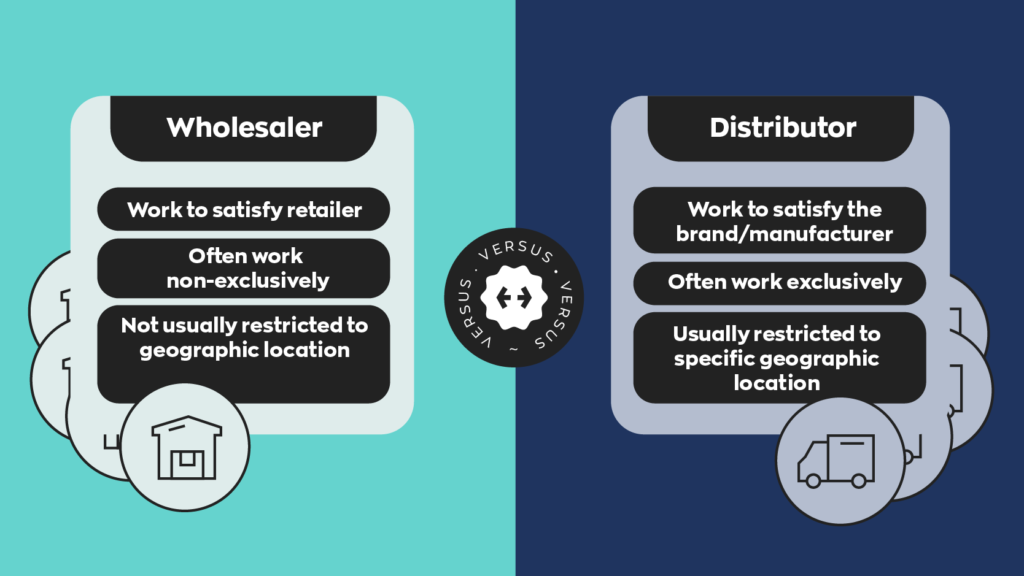
If you’re asking what is a wholesaler, the short answer is that it’s a business that buys products in bulk and resells them to retailers or other businesses. Their focus is satisfying their customer (the retailer’s) needs. focusing on efficient distribution rather than brand representation.
Who wholesalers serve
Wholesalers primarily serve retailers and other businesses that need bulk inventory. Their role is to supply products quickly and reliably to meet demand. A wholesaler has autonomy over the products they trade and won’t usually work exclusively. This means they may sell competitors’ products alongside yours.
Relationship to the manufacturer
Wholesalers typically operate independently from manufacturers. They purchase goods outright and resell them, without formal obligations to represent a specific brand.
Product range
Wholesalers often offer a broad and flexible product range, carrying multiple brands and even competing products. Some specialize in a specific product category. This might be a product type, such as seasonal decorations, jewelry, or books.
Services wholesalers provide
Wholesalers focus on inventory availability and the convenience of bulk purchasing. Their services are usually limited to ordering, storage, and distribution, with minimal involvement in marketing or brand support.
Territory and market coverage
Wholesalers generally operate without exclusivity. They can sell across multiple regions depending on their logistics capabilities, rather than being restricted to a specific geographic area.
What is a distributor?
If you’re wondering what is a distributor, it’s typically the partner that works on behalf of the manufacturer, brand, or publisher to bring products to market. Their aim is usually to supply retailers with that product on behalf of their clients, and often play an active role in bringing those products to market.
Who distributors serve
Distributors serve manufacturers, brands, or publishers by helping them reach the right buyers. They also work with retailers, resellers, and sometimes wholesalers who purchase and sell the products.
Relationship to the manufacturer
Distributors typically have a direct, formal relationship with the manufacturer, often acting on their behalf. This relationship may include agreements around pricing, branding, and market responsibilities.
Product range
Distributors usually carry a limited, curated product catalog, often focused on a single brand or a small set of related products. They often work exclusively, meaning they cannot sell competing products.
Services distributors provide
Distributors provide value-added services such as product promotion, sales support, coordination among partners, and maintaining a line of communication across the supply chain.
Territory and market coverage
Distributors often work within a specific geographical area. They may have exclusive rights to sell a product in a specific region, making territory a key part of their role.
Wholesaler vs distributor side-by-side
A wholesaler and a distributor both move products through the supply chain, but they differ in who they represent, how they operate, and the value they provide. The table below breaks down the key differences side-by-side.
| Key Difference | Wholesaler | Distributor |
|---|---|---|
| Primary role | Buys in bulk and resells to businesses | Represents and distributes products for a manufacturer or brand |
| Who they serve | Retailers and other businesses | Manufacturers and brands (primary), plus retailers/resellers |
| Relationship to manufacturer | Independent buyer/reseller | Formal partner, often under contract |
| Product range | Broad; multiple brands (including competitors) | Narrow; usually one brand or a limited product catalog |
| Exclusivity | Rare | Common (brand and/or territory) |
| Services | Basic: purchasing, storage, resale | Value-added: marketing, sales, training, and support |
| Territory | Flexible; no fixed boundaries | Defined regions, often exclusive |
| Inventory ownership | Owns inventory | May own inventory but tied to agreements |
| Typical use case | Sourcing variety and flexibility | Helping build and support a brand within a market |
Wholesalers and distributors play complementary yet distinct roles in the supply chain. Wholesalers focus on access and variety, making it easier for retailers to source a broad range of products from one supplier.
Distributors, meanwhile, focus on control and growth by helping manufacturers expand into new markets with structured support, brand representation, and closer oversight.
In many supply chains, both are essential. Distributors help build and manage the market, while wholesalers keep products moving efficiently to retailers within it.
Wholesaler vs distributor example
To see the difference more clearly, let’s look at an example. Amy Collins, President of New Shelves Books, explains how authors and publishers might work with wholesalers and distributors in different ways.
She says that wholesalers work for bookstores, libraries, and online retailers. Their job is to supply books to those people, their customers.
Meanwhile, a distributor works for the publisher. They provide marketing, shipping, customer service, etc., all while helping that publisher get their books into the right store. The distributor is paid a percentage fee, which could be a third of your profit.
When should you choose a wholesaler or a distributor?
So, which one actually makes sense for your business, and should you use a wholesaler or distributor as you grow?
Well, it depends on where you sit in the supply chain and your goals. Are you focused on expanding into new markets? Maintaining brand control? Or just getting products in and out as efficiently as possible?
Let’s break it down.
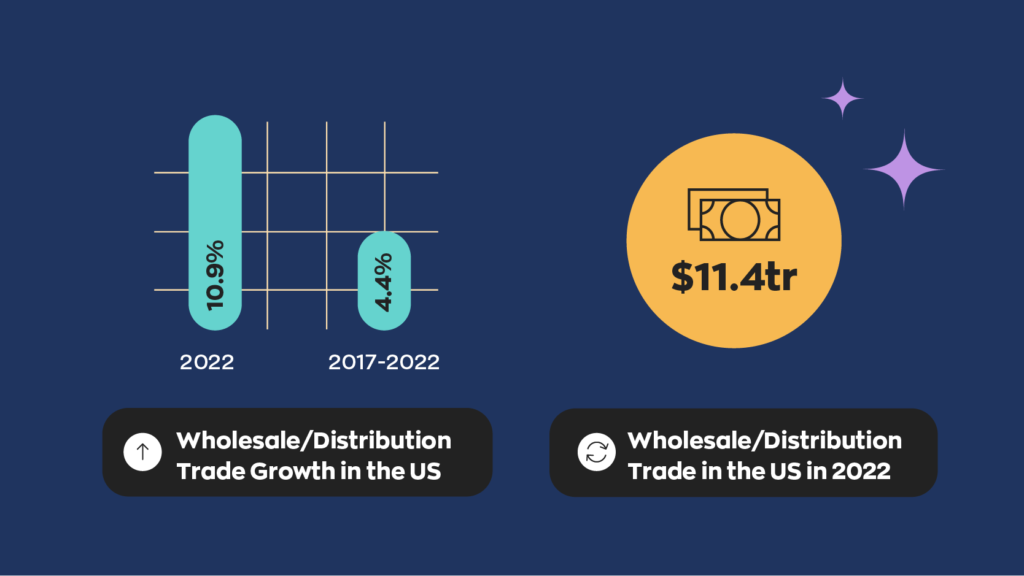
If you’re a manufacturer
Choose a distributor when…
- You want to enter new markets or regions with local expertise
- You need help with sales, marketing, or customer support
- You want stricter control over how your brand is represented
- You sell specialized or high-touch products that require training or education
Choose a wholesaler when…
- You want to move large volumes of product quickly
- You don’t need active promotion or brand support
- You’re okay with your products being sold alongside competitors
- You want broad distribution without managing a lot of relationships
If you’re a retailer or ecommerce seller
Choose a distributor when…
- You need access to specific brands or products
- You want product support, training, or marketing materials
- You sell higher-end, technical, or regulated items
- You value consistent supply and direct brand relationships
Choose a wholesaler when…
- You want to source a wide variety of products in one place
- You care most about price, flexibility, and convenience
- You frequently test new products or rotate inventory
- You don’t need brand-level support or exclusivity
Can you use both?
Short answer: yes, and many businesses do.
Manufacturers often use distributors to build and manage markets, especially when they need to find a distributor for their product, while also working with wholesalers to increase reach and move more volume. On the flip side, retailers might rely on distributors for key branded products, and wholesalers to fill in gaps, test new items, or improve margins.
In other words, you don’t have to choose just one, you can have the best of both worlds! The ideal setup is the one that supports how your business operates.
The difference between retailers and wholesalers
When looking at your supply chain, it’s important to differentiate between retailers and wholesalers. In short, retailers sell in smaller quantities to the end customer. Meanwhile, wholesalers tend to sell larger quantities to retailers.
A wholesaler’s business model is usually based on buying in bulk at a discounted rate. They often need to store large amounts of products (although this will depend on their business model) in their own warehouses.
Faire is a popular platform used by wholesalers and retailers alike. It empowers small businesses and independent brands by connecting them directly with retailers looking for unique, high-quality products. With Faire you can shop over 100,000 independent brands, all in one place. A ton of inFlow customers have been taking advantage of Faire for years, so much so that we even offer an integration with Faire through Extensive.
Are the distinctions always clear between wholesaler vs distributor vs retailer?
Every supply chain works differently. So, to confuse matters a little, that sometimes means the distinction between wholesalers vs distributors vs retailers, and even manufacturers, isn’t clear. For example, you can find stores such as Costco (known as Costco Wholesale Corporation) that buy in bulk and sell to members.
Meanwhile, some businesses will sell to a variety of customers. For instance, Zelda’s Sweet Shoppe, based in Chicago, operates both a wholesale and retail bakery. The wholesale business operates out of the “factory” and ships across the country, while the retail side works out of the original storefront.
Wholesalers working with large quantities of inventory
The nature of the business means that wholesalers find themselves working with large orders and various types of products. So, a lot of inventory passes through their warehouses or storage facilities.
Not only is it essential to keep track of each item, if a wholesaler buys from a range of manufacturers, they might also have to deal with different markups and cost changes too. This can make managing inventory seem like a daunting task.
In reality, working with large quantities of inventory is much easier with the right management tools and processes in place, such as using barcoding tools, finding the right software, organizing warehouse layouts, and more.
It’s vital to get the right systems in place as soon as possible, whether that means adopting wholesale inventory software or other solutions that can adapt as your business scales or changes. That way, you can reduce unwanted costs, maximize efficiency, and keep customers happy.
At inFlow, we offer wholesale software that’s ready for large orders so that you can take full control of your wholesale business.
0 Comments