





Key takeaways
- Lean manufacturing principles focus on minimizing waste while maximizing efficiency in the manufacturing process.
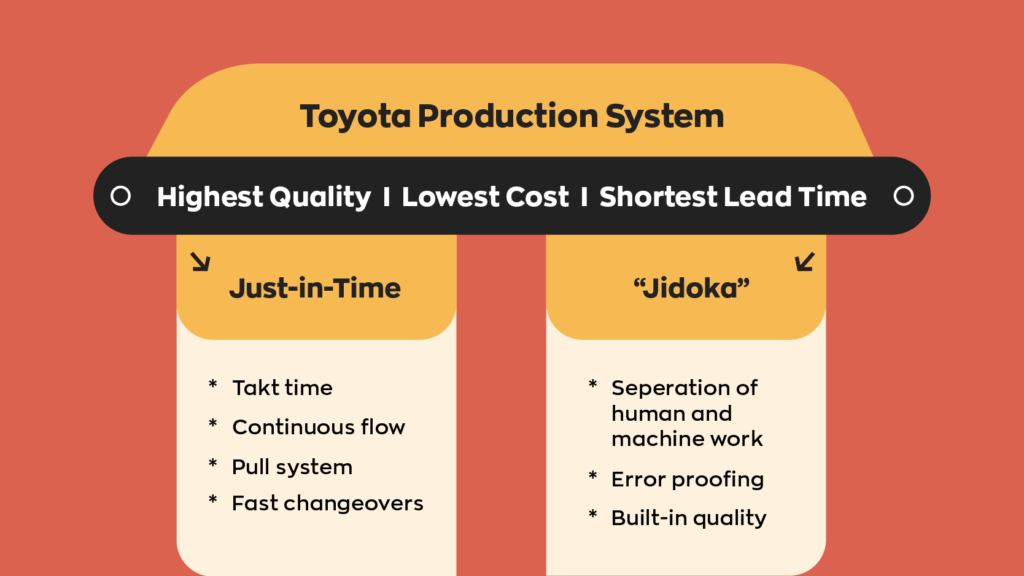
- Lean manufacturing originated from the Toyota Production System (TPS) and is built on two main pillars: Just-in-Time (JIT) inventory and Jidoka (automation with a human touch).
- The five principles of lean manufacturing are identifying value, charting the value stream, optimizing flow, establishing a pull system, and seeking perfection.
- A pull-based production system ensures that products are made based on actual customer demand, reducing excess inventory.
- Lean manufacturing methods help businesses reduce costs, improve quality, and shorten production times by eliminating inefficiencies.
- Continuous improvement is a core concept behind lean manufacturing. It encourages companies to refine and improve processes regularly.
Something that business owners learn very quickly is the importance of time. Not only is it a highly limited resource, but it is also necessary to get anything done, making it a valuable currency. It is the main reason businesses are always looking for ways to increase efficiency. Naturally, this carries over to the manufacturing side of things as well.
Lean manufacturing is a product of this ideology. So, what is lean manufacturing? How does it relate to the Toyota Production System (TPS)? And how does it reduce waste for manufacturers?
For the TLDR on lean manufacturing, watch this short clip from our new podcast!
What is lean manufacturing?
Lean manufacturing is a manufacturing strategy that seeks to reduce waste through optimized manufacturing processes. In particular, lean manufacturing systems focus on reducing production times at each stage of the manufacturing process as much as possible. The exact process differs from industry to industry, but the core principles remain the same.
Toyota Production System (TPS): the foundation of lean manufacturing
In order to understand lean manufacturing, it’s necessary to have an understanding of the TPS or Toyota Production System. First coming into prominence in the 1950s, the TPS functions based on two core “pillars”: JIT and jidoka.
The two pillars of TPS: Just-in-Time and Jidoka
Just-in-Time (JIT)
Just-in-time (JIT) is the principle that each process only produces what the following process needs. It also minimizes the amount on hand, increasing cash flow. So, put simply, it’s making what’s needed, when needed, in the amount needed.
Jidoka
Jidoka is a Japanese term that describes a concept that is a bit more complex. It roughly translates to “automation with a human touch.” To keep things simple, this means that when an error occurs, the manufacturing process stops, which prevents defective products.
Kaizen and the 3M model: muda, mura, muri
Lean manufacturing is closely related to Kaizen, a philosophy that teaches continuous, incremental improvement. Kaizen encourages manufacturers to constantly refine their processes, eliminate waste, and improve workflows over time, rather than making large, infrequent changes.
A key framework within Kaizen is the 3M model, which identifies three major sources of inefficiency in production systems:
- Muda (waste): Steps in a process that consume time or resources but don’t create value for the customer. For example, producing excess inventory that ends up sitting in storage.
- Mura (unevenness): Inefficiencies caused by inconsistent workflows or production processes. For example, if shift #1 produces 100 units using one process while shift #2 produces 150 units using another, the inconsistency creates instability in the system.
- Muri (overburden): Overloading machines, systems, or workers beyond a reasonable capacity. This could be as simple as setting unrealistic production quotas, causing workers to rush to meet targets, leading to errors or breakdowns.
The 5 principles of lean manufacturing
There are five major principles that any business should follow in order to successfully implement lean manufacturing. These principles are as follows:
1. Define value (customer-first)
This principle asks businesses to understand what value their products provide to their customers. This can reduce costs by cutting out unnecessary product features. Further, you may be able to reduce waste by adding features that are appealing to your customer base. For example, an eco-conscious customer base may find value in an adjustment to packaging that reduces the use of plastic and other materials.
2. Map the value stream (current state → future state)
A value stream is a construct that shows how a product creates value. To document the value stream, track the product throughout the manufacturing steps that develop the value of the product. In doing this, you will better understand what steps you must take to add value to those products or what steps could be made more sustainable or efficient.
3. Create flow (reduce bottlenecks and waiting)
Maintaining flow means moving products and components through processes as efficiently as possible. This reduces idle time and helps eliminate bottlenecks and/or blockages. Improving the flow should not only optimize workflows within every department, but also those shared between departments.
4. Establish pull system (produce to real demand)
It is important to note that pull systems are not exclusive to lean manufacturing, but in that context, a pull system manufactures products according to demand. When an order comes in, a new work order is created. This increases cash flow and minimizes capital tied up in different types of inventory, such as work-in-progress inventory and stored finished goods.
5. Pursue perfection (continuous improvement cycles)
Just to be clear, perfection is an impossibility. Human error is a constant, and even if it weren’t, machines malfunction. Still, though, perfection — or as close to it as you can get — is an essential part of lean manufacturing. Lowering the margin of error reduces defective units, saving money.
The 7 wastes of lean manufacturing (TIMWOOD)
Traditionally, there are 7 common types of waste that lean manufacturing aims to eliminate. You can remember these wastes using the acronym TIMWOOD. Each waste item represents something that consumes resources or adds to manufacturing costs but provides no value to the customer.
- Transportation: Unnecessary movement of materials or products between locations.
- Inventory: Excess raw materials, work-in-progress (WIP), or finished goods that are not immediately needed.
- Motion: Workers moving around their workstation unnecessarily, without adding value.
- Waiting: Idle time when people, machines, or materials are delayed or shut down.
- Overproduction: Producing more products than customers demand.
- Overprocessing: Performing extra steps or using overly complex processes that don’t add customer value.
- Defects: Errors that require rework, repair, or scrap.
The “8th waste” of lean manufacturing
Recently, many lean manufacturers have identified an eighth waste: unused human potential. This occurs when companies fail to fully utilize an employee’s knowledge, creativity, and skill set. A common example of this is not asking your workers for feedback on process inefficiencies. Since they spend their day-to-day carrying out production processes, their insights offer the most value.
Lean manufacturing tools and techniques
Lean manufacturing can be implemented through practical tools and techniques that help teams visualize work, control production flow, and standardize processes. The following methods are commonly used to reduce waste and improve manufacturing efficiency.
Value stream mapping (VSM)
Value stream mapping (VSM) is a visual method for analyzing every step required to produce and deliver a product. It maps process steps, material flow, information flow, wait times, and inventory levels. Manufacturers use VSM to identify bottlenecks, delays, and non-value-adding steps, then redesign processes to improve flow.
Kanban and visual management (pull signaling)
Kanban is a visual system that controls production using pull signals instead of demand forecasts. When a workstation consumes parts, a signal (such as a Kanban card, bin, or digital alert) triggers replenishment. This helps manufacturers prevent overproduction, reduce excess inventory, and make production flow visible.
5S workplace organization
5S is a lean method for organizing and maintaining efficient workspaces.
The five steps are:
- Sort – remove unnecessary items
- Set in order – organize tools and materials
- Shine – clean and inspect work areas
- Standardize – create consistent procedures
- Sustain – maintain discipline through audits
A well-implemented 5S system reduces motion waste, safety risks, and production delays.
Standard work and continuous improvement routines
Consistent processes start with standard work documents. These will outline the most efficient way to complete a task and typically define task steps, work sequence, expected timing, and quality checks.
Once work is standardized, teams can apply continuous improvement (Kaizen) to refine processes and eliminate waste over time.
Takt time vs cycle time vs lead time (how to use each)
Lean manufacturing uses several time metrics to evaluate production performance: takt time, cycle time, and lead time.
| Metric | What it measures |
|---|---|
| Takt time | Required production pace to meet customer demand |
| Cycle time | Actual time needed to produce one unit |
| Lead time | Total time from order placement to delivery |
Understanding these metrics helps manufacturers determine whether production capacity matches demand.
Takt time formula (and common pitfalls)
The takt time formula is:
Takt Time = Available Production Time ÷ Customer Demand
Manufacturers use takt time to balance production across workstations. However, ensure you don’t include the total shift time when calculating your takt time. Only include the available production time.
Cycle time formula (and how to reduce it safely)
The cycle time formula is:
Cycle Time = Total Production Time ÷ Units Produced
The important thing to remember is that if cycle time exceeds takt time, production will fall behind demand, so it’s important to monitor both takt time and cycle time. You can reduce cycle time by improving layout, removing unnecessary motion, and reducing setup time.
Lean manufacturing KPIs to track
Like anything, lean manufacturing improvements should be measured using clear KPIs. Tracking the right metrics helps teams verify that changes are actually improving the production process and providing real value. Below are key KPI categories manufacturers commonly use to evaluate lean initiatives
Flow metrics: lead time & cycle time
Measuring things like cycle time and lead time will tell you how quickly you can manufacture products and meet demand. Reducing these metrics usually indicates better flow and fewer delays.
Inventory: WIP, inventory turnover, & stockouts
Inventory metrics help identify issues like overproduction, excess stock, and supply disruptions. Look at factors such as the amount of work-in-progress (WIP) inventory currently moving through production, inventory turnover, and the frequency of stockouts.
Quality: defects, rework, & first pass yield
Tracking quality KPIs is just as important as speed-related ones. This includes the defect rate, rework rate, and first-pass yield (FPY). The defect rate is the percentage of units that fail quality checks, while the rework rate is the percentage of units that require additional work before completion. First-pass yield (FPY) shows the percentage of units that pass through production without rework.
Delivery: on-time/in-full
Delivery metrics track how consistently manufacturers meet customer commitments. On-time-in-full (OTIF) measures whether orders are delivered on schedule and in the correct quantity. Strong OTIF performance indicates that production, inventory, and logistics processes are well aligned with customer demand.
Benefits of lean manufacturing
The goal of lean manufacturing is simple: use fewer resources while producing the same or better results. When implemented well, lean systems can provide businesses with a ton of benefits.
Cost reduction through waste elimination
One of the biggest benefits of lean manufacturing is cost reduction. By identifying and eliminating waste such as excess inventory, unnecessary movement, overproduction, and rework, manufacturers can significantly lower operating costs.
These savings may seem small at first. But because lean improvements affect multiple stages of production, the impact compounds quickly. Even saving a small amount per unit can add up to tens or hundreds of thousands of dollars over time.
Shorter lead times and improved throughput
Lean manufacturing focuses on improving workflow efficiency and removing bottlenecks. When production steps are streamlined and unnecessary delays are eliminated, products move through the system faster.
This leads to shorter lead times and improved throughput, allowing manufacturers to fulfill orders more quickly while using the same equipment and labor.
Better quality and fewer defects
Lean manufacturing also emphasizes quality control and standardization. By reducing variability and catching problems earlier in production, manufacturers can reduce defect rates and minimize rework.
Higher first-pass yield and fewer quality issues not only reduce waste but also improve customer satisfaction.
Risks, tradeoffs, and common failures
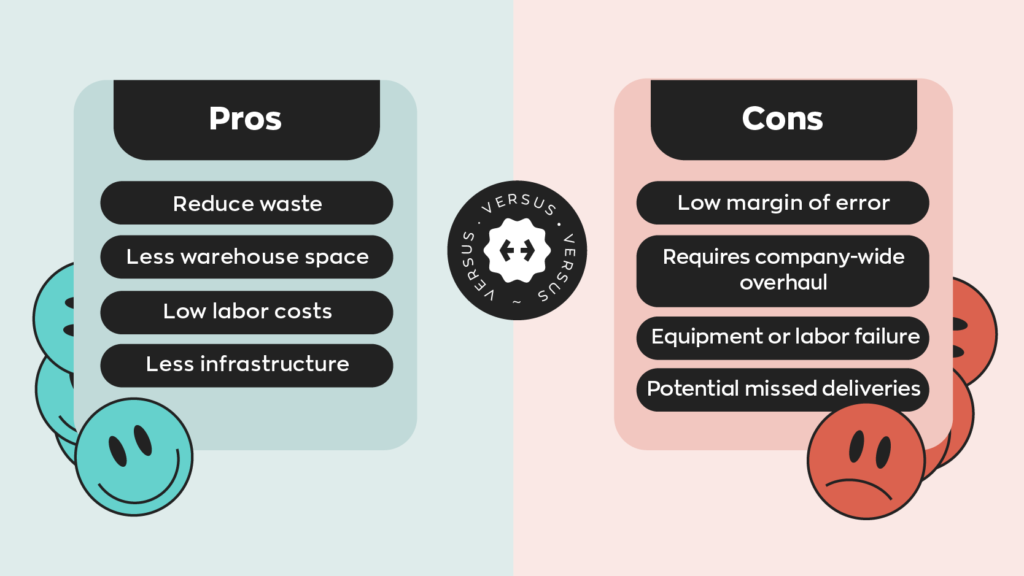
While lean manufacturing can deliver major improvements, it also comes with tradeoffs. Businesses need the right processes, data, and supply chain reliability to make lean systems work effectively.
Low buffer risk in pull/JIT environments
Lean manufacturing often relies on pull systems and just-in-time (JIT) inventory. These approaches reduce excess inventory but also leave very little room for error. Without buffer stock, even a small shortage can create bottlenecks throughout the entire production process.
Process redesign and training expectations
Lean manufacturing is not something that can be implemented overnight. Identifying inefficiencies, redesigning workflows, and training employees all take time. Successful lean transformations require consistent process monitoring and employee buy-in.
Constraints and data quality
In some cases, lean manufacturing is not the best place to start. Before pursuing lean initiatives, companies often need to improve data tracking, inventory visibility, and operational consistency. Businesses that lack reliable data, standardized processes, or stable production environments may struggle to implement lean practices effectively.
How to implement lean manufacturing: a practical starter plan
Lean manufacturing is not a one-off project. It requires ongoing effort focused on continuous improvement. Teams need to regularly review data, identify inefficiencies, test improvements, and refine processes over time. Small gains made consistently will compound over time into incredible operational improvements.
Choose a value stream or production process and baseline metrics
The best place to start is by selecting a single value stream or production process to improve. Measure key baseline metrics such as lead time, defect rate, work-in-progress (WIP), and inventory levels. Establishing these benchmarks gives you a clear starting point and helps you measure whether lean improvements are actually working.
Map the current workflow, identify wastes, and pick the first process to improve
Next, map the current workflow from raw materials to finished goods. This makes it easier to spot waste such as unnecessary movement, waiting time, overproduction, or excess inventory. From there, choose the first process to improve. Starting small allows teams to test lean ideas without disrupting the entire operation.
Implement flow and pull changes, then standardize
Once opportunities are identified, begin introducing improvements that support smoother workflow and pull-based production. This may include reducing batch sizes, reorganizing workstations, or improving material flow. After the improvements prove effective, standardize the new process so teams follow the same procedures consistently.
Sustain with kaizen cycles and visual management
Lean systems rely on continuous improvement. Regular reviews, performance dashboards, and visual management tools help teams identify problems early and keep progress moving forward. These ongoing kaizen cycles ensure that improvements are maintained and that new inefficiencies are addressed as they appear.
How manufacturing and barcoding software support lean manufacturing
Lean manufacturing depends on accurate information. Without clear visibility into inventory and production activity, it becomes difficult to identify waste or maintain reliable lean systems.
Our manufacturing software inFlow is the perfect foundation for lean manufacturing. It provides real-time visibility into stock levels, work-in-progress, and material usage. This level of visibility helps manufacturers maintain lean inventory levels while still ensuring materials are available when needed.
We also have a built-in barcoding system in the software, which makes it easier to track materials as they move through receiving, storage, production, and shipping. Scanning items reduces manual data entry, improves accuracy, and speeds up routine tasks. Better traceability also helps teams quickly identify issues such as missing components, incorrect picks, or quality problems.
Solutions like inFlow combine inventory tracking with manufacturing tools, giving businesses the visibility they need to manage materials, control production, and continuously improve their operations.




0 Comments