




Key takeaways
- Proper inventory accounting involves tracking all materials, including raw materials, work-in-progress, and finished goods.
- Inventory accounting aims to ensure that all financial records are accurate and up to date.
- Which inventory costing method you choose will have a major impact on your inventory accounting.
- The most common inventory valuation methods are first-in, first-out (FIFO), last-in, first-out (LIFO), and moving average.
- Another key metric involved with inventory accounting is cost of goods sold (COGS).
- COGS helps businesses determine the direct costs associated with producing or purchasing the goods they sell.
- Some inventory accounting best practices include cycle counts, adopting inventory software, and standardizing processes.
Accounting for your inventory for small busineses can be tricky! You have to be sure to include your raw materials, work in progress, as well as the finished goods that you have on site. Your inventory is a current asset on the balance sheet, so whoever handles your accounting needs accurate valuations to avoid issues with your financials.
Today, we’ll focus on everything related to inventory accounting, including costing methods, cost of goods sold (COGS), and more. So, let’s put on our bookkeeping hats and get started!
What is inventory accounting? Definition, scope, and why it matters
Simply put, inventory accounting is the process of tracking, managing, and adding value to your inventory to ensure accurate financial records. For proper inventory accounting, you’ll need to consider things like costing methods and COGS. These metrics are pivotal for your accountant when calculating numbers like the markup on your products.
What counts as inventory: raw materials, WIP, finished goods, MRO, & Packing materials
In inventory accounting, inventory refers to the goods your business needs to continue operating. Most businesses organize their inventory into 5 categories:
- Raw materials: Basic inputs used to manufacture products.
- Work-in-progress (WIP): Items currently in production but not yet finished.
- Finished goods: Completed products ready to be sold to customers.
- MRO inventory: Maintenance, repair, and operations supplies used to support production but not part of the final product.
- Packing materials: Packaging used to store, protect, or ship finished goods.
Together, these categories represent the full lifecycle of inventory, from inputs used in production to products ready for sale.
Why inventory accounting matters: taxes, margins, stockouts, overstock
Accurate inventory accounting ensures your financial data reflects what’s actually happening in your day-to-day business. Your inventory directly correlates with your income (and therefore income tax) because you document the inventory you sell as an expense. Effective inventory accounting helps businesses:
- Maintain accurate financial records.
- Calculate taxes.
- Determine profit margins.
- Avoid stockouts or excess inventory.
- Make informed procurement decisions.
In short, inventory accounting connects your operations with your financial reporting. When inventory is tracked and valued correctly, it becomes easier to understand how efficiently your business generates revenue.
Inventory accounting vs inventory management: valuation vs operations
Inventory accounting and inventory management are closely related, but they serve different purposes.
- Inventory accounting focuses on the financial value of inventory. It tracks how much inventory costs, how it’s recorded on financial statements, and how inventory expenses impact cost of goods sold (COGS) when items are sold. This information is primarily used for financial reporting, tax calculations, and understanding profitability.
- Inventory management, on the other hand, focuses on how goods move through your business. It involves tracking stock levels, managing reorder points, preventing stockouts, and ensuring the right products are available when customers need them.
In simple terms, inventory accounting answers “What is our inventory worth?” while inventory management answers “Where is our inventory, how much of it do we have, and how do we control it?” Most businesses rely on both to maintain accurate financial records and run efficient day-to-day operations.
Inventory costing methods for inventory valuation
Inventory costing methods define the rules for assigning costs to the inventory you sell and the inventory you still hold. Choosing a method helps ensure that inventory is consistently valued in your accounting records and financial statements.
How costing methods affect COGS, profit, and taxes
The inventory costing method you choose determines how inventory costs move from your balance sheet to COGS. Because COGS directly affects your reported profit, the FIFO vs LIFO tax implications (and the impact of other costing methods) can significantly affect your financial statements and tax obligations.
Businesses can choose from several inventory costing methods, the most common being first-in-first-out (FIFO). Other methods include last-in-first-out (LIFO), weighted average cost, and the specific identification method. Let’s take a closer look at each and how they will impact your inventory accounting.
FIFO (first-in, first-out): definition, pros/cons, & example
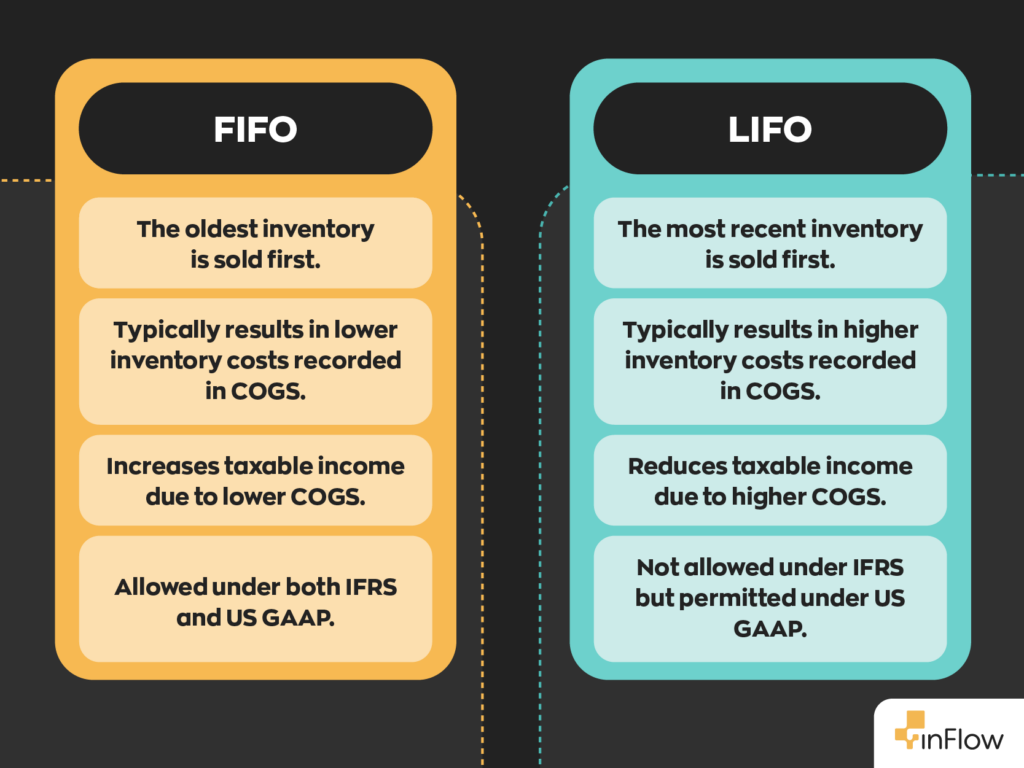
The FIFO method assumes you always sell the oldest items in your inventory first. Essentially, you sell your products in the order you procure them, hence the name first-in-first-out. Most companies use FIFO for their inventory accounting, which usually offers lower COGS and higher profits. However, this costing method also may increase tax liabilities.
Example: Let’s say we own a furniture store and buy 25 office chairs for $25 each. A month later, we purchased 25 more office chairs, but this time for $30 each. We then receive an order for 30 office chairs for $1800. Using the FIFO inventory costing method, we would first use the 25 office chairs worth $25 each, and the remaining 5 chairs would come from the shipment that cost $30 each. This would bring the total cost of the chairs to $775, with a profit margin of $1025.
LIFO (last-in, first-out): definition, pros/cons, & example
With the name last-in-first-out, I’m sure you may be able to guess how LIFO works. In the LIFO method, you assume that the items bought last are the ones that are sold first. This inventory costing method doesn’t typically follow the natural flow of inventory but can be advantageous in times of inflation, as it leads to higher COGS and lower taxable income.
Example: To return to the example above, let’s say our business uses LIFO instead of FIFO. In that case, we would first take the 25 chairs from the $30 shipment and then the last 5 from the $25 shipment. This would bring the total cost of the chairs to $875, with a profit margin of $925.
It’s important to note that the International Financial Reporting Standards (IFRS) has banned this costing method.
Moving average costing: definition, pros/cons, & example
Moving average costing (sometimes called the average cost method) recalculates the average cost of inventory after every purchase. The calculation takes the total cost of the purchased items divided by the number of items in stock. This costing method is effective at smoothing out price fluctuations and providing a balanced approach to inventory valuation.
Example: Using the above example, let’s examine how moving average costing impacts inventory accounting. First, we would divide the total cost for both shipments by the number of chairs purchased. This would give us a moving average of $27.50, meaning the total cost of the chairs is $825, with a profit margin of $975.
Specific identification method: definition, pros/cons, & example
This method keeps the cost of each and every item you have in your inventory. It’s typically only used for very high-cost and unique items such as cars or rare diamonds.
Example: Let’s say our furniture store also sells rare hand-crafted mahogany tables. Over a few months, we purchased 6 tables at various prices. For the first table, we paid $1000, then $1100, then $1200, and so on. We then sold 3 of those tables for $5000, to which we gave them the first 3 tables we purchased. Thus, the total cost of the tables is $3300, with a profit margin of $1700.
How to choose a costing method: decision checklist by industry and region
Choosing the right inventory costing method depends on two things. The first is how inventory flows through your business, and the second is the accounting rules in your region. Below, we’ve provided a set of questions to help you determine which costing method is right for you.
- Does your inventory typically sell in the order it’s purchased or produced?
If yes, FIFO may best reflect how goods actually move through your business. - Do your inventory costs change frequently?
If prices fluctuate often, different costing methods can significantly affect your reported COGS and profit. - What costing methods are common in your industry?
Many industries follow standard practices. For example, manufacturers often use FIFO or weighted average. - Are there accounting rules in your region that limit your options?
For instance, LIFO is not allowed under IFRS, which applies in many countries outside the United States. - How detailed is your inventory tracking?
Methods like specific identification require tracking the cost of individual items, which usually only works for high-value or serialized products.
Whatever method you choose, the key is consistency. Applying the same costing method over time keeps your financial reporting accurate.
COGS in inventory accounting
COGS is one of the most important concepts in inventory accounting because it connects inventory costs with the products you actually sell. Understanding how this works helps businesses track profitability, price products correctly, and report income accurately.
COGS definition
Your COGS is basically the cost of the items you sold over a time period. It affects taxation as businesses can deduct their COGS from revenue to lower their taxable income. Cost of goods sold also helps businesses evaluate their overall profitability and pricing strategies.
COGS formula with example
The formula for COGS looks like this:
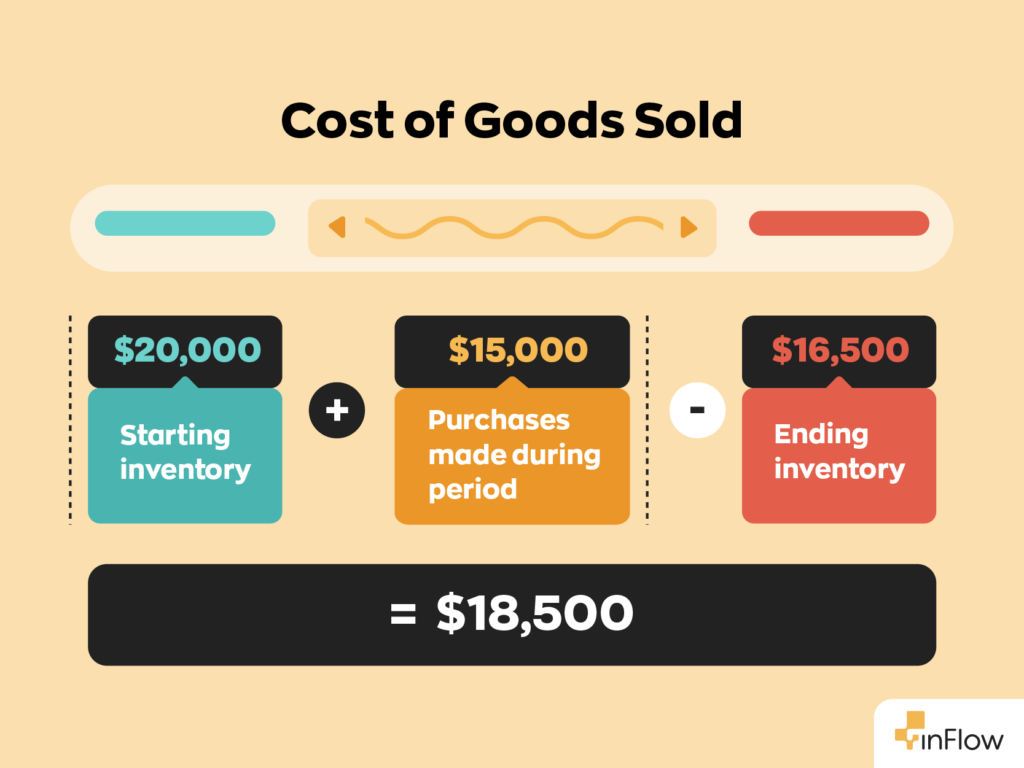
Breaking the formula down piece by piece, here’s what we get:
- Starting inventory—This represents the value of inventory a business has at the start of an accounting period, including any unsold items carried over from the previous period.
- Purchases—This represents the total cost of all inventory items during the accounting period. It may include expenses related to acquiring the inventory, such as shipping, taxes, and handling fees.
- Ending inventory—This represents the value of any unsold inventory during the accounting period.
Example: To return to our furniture store example, let’s examine the cost of goods sold for the office chairs we mentioned. We started our accounting period with 50 office chairs, with a total cost of $1375. We spent $300 on shipping and other fees related to that inventory. After the accounting period, we sold 30 of our 50 office chairs. For this example, let’s assume we’re using the moving average costing method, which means the chairs cost $27.50 each. Therefore, our COGS would be:
($1375 + $300) – $550 = $1125
As the above example shows, the inventory costing method you choose will impact your COGS and, ultimately, your inventory accounting.
Inventory accounting best practices
Everything mentioned above are just some of the many things you’ll need to consider when accounting for inventory. We get it. It can be pretty overwhelming, but we have some tips and tricks to help you keep your head above water:
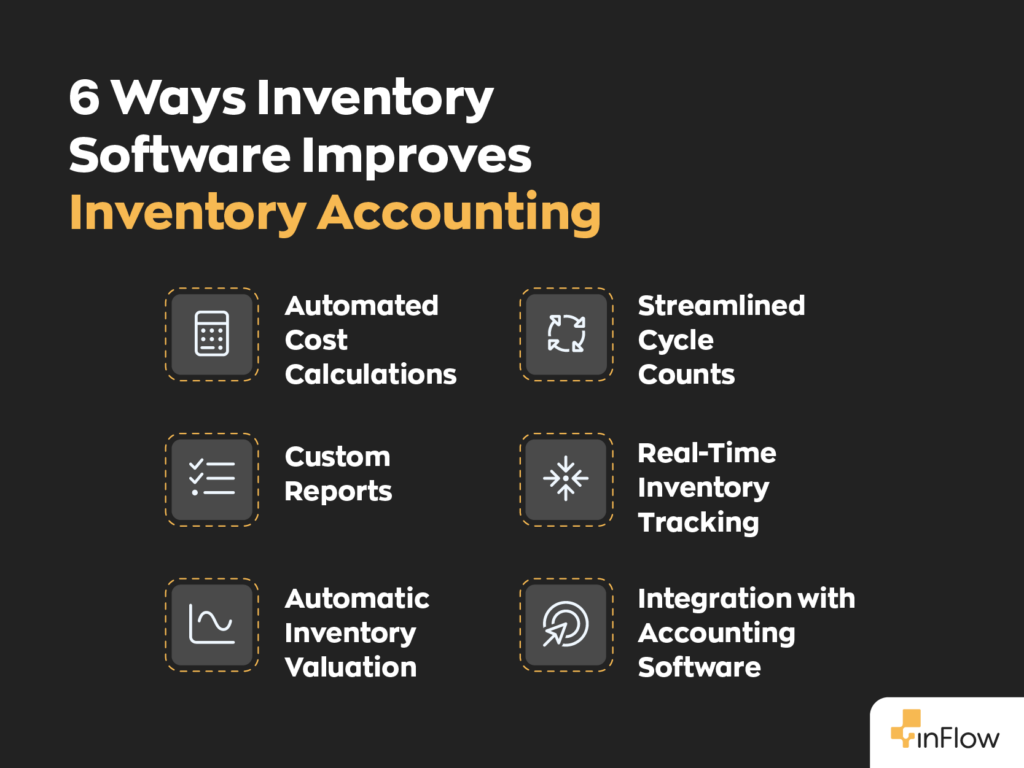
- Use inventory management software—You don’t use spreadsheets or a pen and paper when managing your inventory for the same reason you don’t use an abacus for arithmetic. Software solutions like inFlow have features that make inventory accounting a breeze.
- Perform regular audits—Cycle counts are a pain. They’re time-consuming and sometimes require you to pause your business operations completely. However, we can’t stress enough how vital they are for accurate inventory accounting.
- Monitor stock levels—When you order excess inventory, you will run into all kinds of complications when it comes to your accounting. Monitoring your stock levels as closely as possible can help prevent this.
- Standardize procedures—Standardization is valuable in all aspects of business, including inventory accounting. Establish clear policies for accounting, inventory tracking, purchasing, and valuation.
- Leverage reports—If you’re using inventory software, chances are you’ll have loads of reports you can generate with just a few clicks. Take advantage of them!
Inventory accounting tools and software
Managing inventory accounting manually can quickly become unmanageable. Especially if you’re trying to manage everything in accounting software alone.
Inventory software automates key tasks such as tracking stock value, calculating COGS, and generating financial reports, making it easier to maintain accurate records and connect your inventory data to your accounting system.
What to look for: costing methods, audit trail, integrations, reporting
When evaluating inventory software, look for features that support accurate valuation, financial transparency, and seamless accounting workflows, such as:
- Multiple costing methods: Support for FIFO, LIFO, or average cost so you can apply the method your business uses for inventory valuation.
- Audit trail: A clear history of inventory adjustments and transactions for accountability and easier audits.
- Accounting integrations: Look for inventory accounting software with QuickBooks Online and Xero integrations to keep inventory and financial records in sync.
- Reporting tools: Built-in reports that help you track inventory value, COGS, margins, and inventory movements.
How inFlow supports FIFO/LIFO/average, auto-calculates COGS, and more
Our software inFlow is perfect for anyone looking to automate their inventory accounting. For example, you can choose from several costing methods for your products, such as LIFO, FIFO, and the moving average. From there, inFlow can automatically calculate your COGS—no need for a formula.
Additionally, inFlow offers robust reporting features that provide insights into your cost of goods sold (COGS), inventory movements, and profitability.
Accounting integrations: QuickBooks Online and Xero
inFlow also integrates seamlessly with QuickBooks Online and Xero, offering a two-way payment sync option. This makes it easy to synchronize inventory data with accounting records and ensures that financial statements remain accurate.
Conclusion
Inventory accounting plays a crucial role in understanding your business’s true profitability. By tracking inventory correctly, choosing the right costing method, and maintaining consistent records, businesses can produce more accurate financial statements and make more informed decisions.
With the right processes and the right software in place, inventory accounting becomes much easier to manage, ensuring your financial data stays accurate as your business grows.


0 Comments